Minestra is a beloved Maltese vegetable soup that has warmed family tables for generations. It’s made with seasonal vegetables and slow-simmered to perfection, it’s the kind of nourishing dish that feels just right for a winter’s day dinner.

What is Minestra?
Minestra is one of those traditional Maltese dishes that almost everyone has an opinion about. It’s loved, debated, and sometimes avoided (especially by kids). But it’s undeniably a staple of Maltese home cooking. This vegetable-packed soup has been served in Maltese households for generations, especially during the colder months, when a warm bowl of minestra feels like comfort in its simplest form. Unlike smooth soups, Maltese minestra is all about texture. I grew up hearing endless discussions about how it ‘should’ be eaten: some prefer it brothy, with clearly defined chunks of vegetables, while others like to mash it into a thicker, heartier soup (just how I like it!). In true Maltese fashion, there’s no right or wrong way, just the way your family made it.

One of the things that makes minestra so special is how humble it is. It’s usually made using whatever vegetables you already have at home, which is why the ingredients are classic Maltese kitchen staples. Cabbage, potatoes, carrots, pumpkin, beans, kohlrabi; not fancy ingredients, just wholesome food that feeds the whole family.
Visually, minestra isn’t the most attractive dish and say it is. But what it lacks in looks, it more than makes up for in flavour. Slow-cooked and full of vegetables, it’s deeply nourishing and satisfying, the kind of meal that warms you from the inside out on a winter’s evening. In fact during colder months, it’s a common weekly dish to prepare.


What’s the difference between Minestra and Kawlata?
Minestra and Kawlata actually start from the same vegetable base recipe, which is why they’re so often confused. The key difference lies in the protein. Minestra is traditionally vegetarian, relying entirely on vegetables, pulses, and slow cooking for its flavour. Kawlata, on the other hand, takes that same base and adds slow-cooked pork shanks (smoked or unsmoked) or a chunk of bacon, which transforms the dish into something richer and more robust. The pork is cooked gently with the vegetables, allowing its flavour to infuse the broth and deepen the overall taste. While minestra remains a lighter, everyday vegetable soup, kawlata is heartier and more indulgent, often reserved for those days when you want something extra filling. Same roots, same comforting base; just two very different outcomes depending on what goes into the pot.

My family’s twist
Growing up, minestra wasn’t my favourite dish. Like many children, I needed a little convincing. My mother, of course, found a solution: small chunks of kefalotiri or pecorino cheese in the minestra. It was her trick, and it worked. It’s actually very common for the Maltese to sprinkle grated cheese on top a bowl of minestra, however my mother puts it directly in the mix. And, let me tell you it’s the best thing! After tasting it the first time with cubed cheese in the soup, I used to ask her to make. It was a drastic change and she considered this a HUGE success! Just to be clear, though; there’s no soft cheese in minestra. That’s something we leave to the soppa tal-armla, another traditional Maltese dish.


FAQs
Is there enough water?
You might notice that 750ml of water doesn’t cover all the vegetables in the pot, however that’s ok! For this dish, not overfilling the pot is that best, especially because vegetables like cabbage release plenty of liquid as they cook. Adding more water might make your minestra more watery and even excess water might spill out whilst cooking.
Can I store leftovers?
Yes! Ideally, leftovers should be stored without pasta, as it tends to become mushy. However, you can still store leftover minestra in an airtight container and reheat only the amount you need in a saucepan.
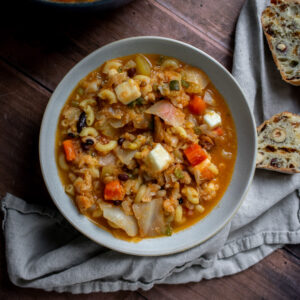
Minestra – Traditional Maltese Vegetable Soup
Ingredients
- 1/2 small cauliflower
- 1/2 small cabbage
- olive oil
- white onion
- 200 g pumpkin
- 100 g carrots
- 1 tbsp kunserva
- 200 g mixed lentils, pulses and beans
- 1 veg stock
- 1 small kohlrabi
- 1 zucchini
- 750 ml water
- 100 g cubed Kefaloriti or pecorino cheese optional
- 50 g small pasta optional
Instructions
- Wash the mixed lentils, pulses and beans, and let them soak in water for about 1 hour.
- In the meantime, prepare all the vegetables and chop them into small pieces. Drain the lentils and beans, add to a large pot.
- To the pot add all the other ingredients except the pasta and cheese. Add the water, it's ok if the water doesn't cover all the vegetables completely.
- Bring the minestra to a gentle boil. Once it's boiling, lower the temperature and let it simmer while covering the pot with a lid for at least 1 hour (I like to simmer it for 2 hours). Half way through the cooking, I like to gently mash some of the vegetables. However, this depends on how you like your minestra soup.
- In the last ten minutes of the cooking, add the pasta and the cubed cheese, cover the pot and let them cook.
Nutrition
If you have any questions, feedback or comments on this recipe, please leave a comment below. Please also rate this recipe by double clicking on the stars below. If you did make this recipe, tag @apronandwhisk and hashtag #apronandwhisk, as I’m curious to see what you create! Don’t forget to subscribe to the mailing list down below so to received the recipe updates straight to your mailbox!




Mother used to add, and I do today too, a sprig of celery and about two tablespoons of oil.
God bless
Thank you for sharing 🙂 I have never tried it with celery, and this week I heard another person using it for minestra. I might give it a try soon. Usually I use celery only in the brodu.
I remember my late mum used to put in baked beans in tomato sauce 5mins prior to serving.
Interesting! The Maltese like adding in a sneaky in their meals a can of baked beans occasionally, at least my father does that as well 🙂 Will definitely try it!
in nanna tana dejjem kienu jiklu minestra dejjem kuljum ghixu 95 sena
Vera! L-ikel bnin ġid jagħmel 🙂